Best Horror Novels
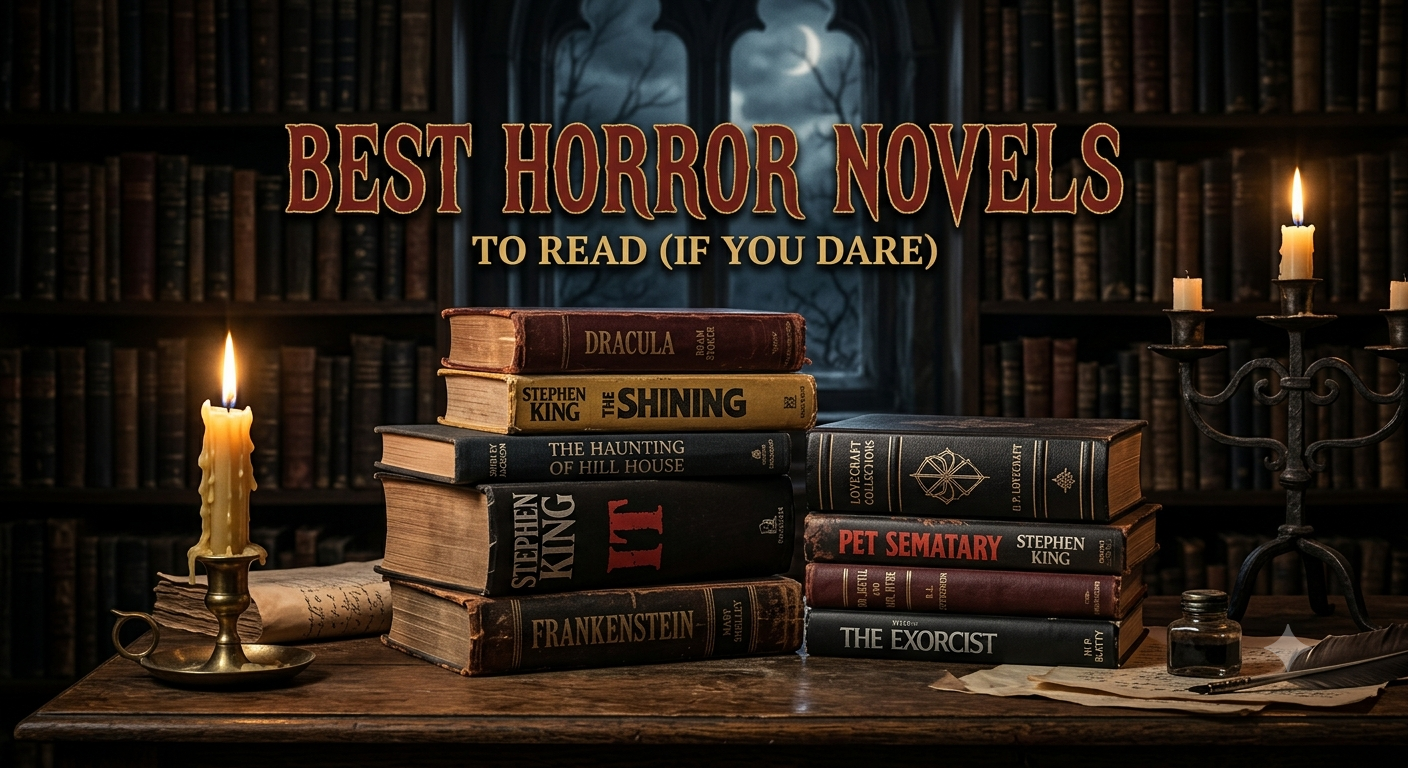
The Best Horror Novels You Need to Read Before You Sleep Again
There is a strange comfort in being scared on purpose. You close the curtains, turn on one small lamp, and open a book knowing full well that something inside it is going to crawl under your skin and stay there. That is the entire appeal of horror fiction, and it is why the genre has survived for more than two centuries without ever going out of style. Long before jump-scare movies and viral creepypasta threads, horror lived on the page, where a single well-placed sentence could do more damage to your nerves than any special effects budget ever could.
This guide walks through the best horror novels across different eras and subgenres, from the gothic classics that invented the rules to the modern bestsellers that are busy breaking them. Whether you're a lifelong horror reader looking for your next obsession or someone who has never picked up a scary book and wants a safe place to start, you'll find something here worth your time.
How to Choose the Right Horror Novel for You
Not all horror is the same, and picking the wrong subgenre for your taste is the fastest way to bounce off a book that everyone else loves. A few quick guidelines:
- If you want slow-burn dread and atmosphere over jump scares, start with Shirley Jackson or Mexican Gothic.
- If you want visceral, high-stakes horror with strong character work, Stephen King's major novels are the safest bet.
- If you want horror that challenges your idea of what a novel can even look like, House of Leaves is worth the effort.
- If you want horror with sharp social or cultural commentary, look at The Only Good Indians or Things We Lost in the Fire.
- If you're horror-curious but easily unsettled, My Best Friend's Exorcism strikes a good balance of scares and humor.
Reading horror is not about proving how much you can tolerate. It's about finding the specific flavor of fear that resonates with you, whether that's supernatural dread, psychological unraveling.
Why Horror Novels Still Matter
Horror is one of the few genres that asks something different of its reader than simple entertainment. A good horror novel doesn't just want to scare you; it wants to unsettle something you believed was stable. It takes ordinary fears — being alone, being watched, losing control of your own body, losing the people you love — and turns them into something you cannot look away from.
That's also why horror ages so well. A thriller can feel dated once its technology or politics move on. A horror novel about grief, isolation, or the fear of what's hiding in the dark barely ages at all, because those fears are timeless. This is part of why so many horror novels from the 1800s and early 1900s are still widely read and referenced today, while also explaining why new horror writers keep finding fresh angles on the same old terrors.
The Gothic Foundations: Where Modern Horror Began
Any serious list of horror novels has to start with the books that built the genre's foundation. These stories established the tropes that horror still leans on today: the haunted house, the corrupted body, the unreliable narrator, and the slow unraveling of sanity.
Frankenstein by Mary Shelley is often credited as the first true work of science-based horror. Written when its author was barely out of her teens, the novel is less about a monster stitched from body parts and more about the horror of creation without responsibility — a theme that still resonates in a world worried about artificial intelligence and unchecked scientific ambition. It's a slower read than modern horror, but the emotional weight it carries is enormous.
Dracula by Bram Stoker did more to shape vampire fiction than any book that came after it. Told through letters, diary entries, and newspaper clippings, the novel builds dread through fragments rather than a single narrator, which makes the reader feel like they're piecing together a nightmare in real time. Every modern vampire story, whether it embraces or rejects Stoker's rules, is in conversation with this book.
The Haunting of Hill House by Shirley Jackson remains one of the finest haunted house novels ever written, and arguably the most influential. Jackson understood that the scariest houses are not the ones with visible ghosts, but the ones that seem to actively despise the people living in them. The novel never fully explains what is happening inside Hill House, and that restraint is exactly why it still terrifies readers generations later.
Rebecca by Daphne du Maurier isn't always shelved under horror, but its atmosphere of dread, its controlling dead woman who haunts a marriage without ever appearing as a ghost, and its slow psychological unraveling put it firmly in horror-adjacent territory. If you enjoy horror that relies on tension rather than violence, this is essential reading.
Stephen King: The Author Who Redefined Mainstream Horror
No conversation about horror novels is complete without Stephen King, and for good reason. Across five decades, King has written horror that works on nearly every register: cosmic dread, supernatural terror, psychological horror, and stories that are frightening simply because they're about ordinary people pushed past their limits.
The Shining remains one of his most iconic works, following a family that takes on the caretaking job of a remote, snowbound hotel with a violent history. The novel's brilliance lies in how it makes an alcoholic father's descent into cruelty just as terrifying as the hotel's supernatural influence — you're never entirely sure where the haunting ends and the human failure begins.
IT is a sprawling, ambitious novel about a group of childhood friends who face a shape-shifting entity that feeds on fear. What makes the book endure isn't just the horror of the antagonist, but how accurately King captures the terror and loyalty of childhood itself, weaving a coming-of-age story into a nightmare.
Pet Sematary is frequently cited, including by King himself, as one of the most disturbing things he has ever written. It deals directly with grief and the desperate, irrational things people do when they refuse to accept death. Few horror novels manage to be this emotionally devastating and this frightening at the same time.
If you're new to King, these three books are the most commonly recommended entry points, though his catalog is enormous and there is likely a King novel suited to almost any specific horror craving you have.
Psychological Horror: When the Real Threat Is the Mind
Some of the most effective horror novels never rely on monsters at all. Instead, they trap the reader inside a narrator's deteriorating grip on reality, making the horror feel personal and inescapable.
House of Leaves by Mark Z. Danielewski is a genre-defying novel built around a house that is somehow larger on the inside than the outside. Its unconventional formatting, footnotes within footnotes, and fractured narrative structure force the reader to physically navigate the book the way its characters navigate the impossible house. It's demanding, but for readers who want horror that experiments with form itself, nothing else compares.
We Have Always Lived in the Castle, another Shirley Jackson classic, is a quieter kind of horror — one built on isolation, family secrets, and the slow reveal of a devastating truth. It proves that horror doesn't need ghosts or gore to leave a lasting impression; sometimes a suffocating atmosphere and an unreliable narrator are more than enough.
The Turn of the Screw by Henry James is a novella often studied for how deliberately ambiguous it is. Are the ghosts real, or is the governess narrating the story losing her mind? That unresolved question is the entire point, and it has kept readers arguing for over a century.
Modern Horror's New Wave
Horror fiction has gone through a genuine resurgence over the past decade, with a new generation of authors bringing fresh perspectives, sharper social commentary, and inventive premises to the genre.
Bird Box by Josh Malerman introduced a terrifying premise: an unseen entity that drives people to violent madness the moment they look at it, forcing survivors to navigate a devastated world blindfolded. Its central conceit is simple but endlessly tense, which is part of why it became such a cultural phenomenon.
Mexican Gothic by Silvia Moreno-Garcia blends classic gothic horror conventions with Mexican history and folklore, following a young woman who investigates her cousin's mysterious new marriage into a decaying, secretive family estate. It's a great pick for readers who love old-school haunted house atmosphere but want something with a distinct cultural voice and a more contemporary pace.
The Only Good Indians by Stephen Graham Jones follows four Native American men haunted by the consequences of a hunting trip a decade earlier. It combines supernatural horror with sharp commentary on identity, guilt, and cultural erasure, and has been widely praised for reinventing the revenge-horror formula.
My Best Friend's Exorcism by Grady Hendrix takes a nostalgic, 1980s-set premise, a teenage friendship torn apart by a possible demonic possession, and plays it with equal parts horror and dark humor. Hendrix has become known for horror novels that are genuinely scary while never losing their sense of fun, and this book is often considered his most beloved.
The Fisherman by John Langan blends cosmic horror with quiet, character-driven grief, following two widowers who go fishing at a legendary spot rumored to bring back the dead. It's a favorite among readers who enjoy Lovecraftian-style dread grounded in real emotional stakes.
Short Story Collections Worth Your Time
Horror has always thrived in shorter forms, where a single unsettling idea can be delivered without the padding a novel sometimes requires.
Things We Lost in the Fire by Mariana Enriquez collects unsettling, socially charged stories rooted in Argentine culture, blending body horror with commentary on poverty, violence, and gender. It's a strong pick for readers who want horror that says something beyond the scare itself.
Get in Trouble by Kelly Link mixes horror with fantasy and surrealism, often leaving readers unsettled without ever fully explaining why. Link's stories reward re-reading, since much of the horror is buried in what's left unsaid.
Night Shift, an early Stephen King collection, is a great introduction to his shorter work and shows how effectively he can build dread in just a few pages, without the sprawl of his longer novels.
Horror Novels From Around the World
While American and British authors dominate most "best horror novels" lists, some of the most inventive horror being written today comes from outside the English-language mainstream, often carrying folklore, history, and social anxieties that feel genuinely new to readers used to the same familiar tropes.
Tender Is the Flesh by Agustina Bazterrica, translated from Spanish, imagines a near-future society that turns to cannibalism after a virus makes conventional meat unsafe to eat. It's less about jump scares and more about the horror of normalized cruelty, and it has drawn comparisons to classic dystopian fiction as much as traditional horror.
Hex by Thomas Olde Heuvelt, translated from Dutch, follows a small town cursed by the ghost of a woman with her eyes and mouth sewn shut, and explores what happens when a community's collective secrecy becomes more dangerous than the curse itself. The novel is notable for how it uses modern technology and social media paranoia as part of its horror, grounding an old-fashioned curse story in a distinctly contemporary setting.
Ring by Koji Suzuki, the Japanese novel that inspired a wave of influential horror films, blends supernatural horror with a slow-building mystery structure closer to a detective novel. Readers who only know the story through film adaptations are often surprised by how much more restrained and cerebral the source novel is.
The Vegetarian by Han Kang isn't marketed as horror, but its unflinching depiction of a woman's psychological and physical unraveling has left many readers describing it as one of the most disturbing books they've encountered, proving that literary fiction and horror aren't always separate categories.
These international voices are worth seeking out if you feel like you've read every major English-language horror author and want the genre to surprise you again.
Horror Novels That Shaped the Films You Already Know
Many horror novels are more famous today because of the films they inspired, but the source material is often stranger, slower, or more emotionally complex than the movie versions. Reading the novel behind a film you already love can completely change how you understand the story.
Novels like The Shining and Pet Sematary carry far more interior psychological detail on the page than any film adaptation has room for, since a novel can dwell inside a character's guilt or addiction in ways a two-hour film simply cannot. Similarly, Ring works as a slow-burn mystery on the page in a way that its more visually driven film adaptations don't fully capture. Even Frankenstein and Dracula, both adapted into countless films over the last century, read very differently in their original text than in almost any screen version, since the films tend to strip away the introspective, often melancholic tone of the original prose in favor of visual spectacle.
If you've only experienced horror through film, working backward to the novels that inspired your favorite movies is one of the most rewarding ways to get into the genre, since you already know the broad shape of the story and can focus on how much more depth the written version adds.
Best Horror Novels - Ever
Here are 30 widely acclaimed horror novels, spanning gothic classics, psychological horror, supernatural terror, cosmic horror, folk horror, and modern masterpieces.
- Dracula
Bram Stoker's Dracula remains one of the most influential horror novels ever written. Told through journal entries, letters, and newspaper clippings, it follows a group of people attempting to stop the ancient vampire Count Dracula from spreading his curse across England. Its eerie atmosphere, memorable villain, and themes of fear, sexuality, and immortality continue to shape vampire fiction more than a century after its publication.
- Frankenstein
Often regarded as the first science-fiction horror novel, Frankenstein tells the tragic story of Victor Frankenstein, who creates life through scientific experimentation. Instead of celebrating his achievement, he abandons his creation, leading to devastating consequences. The novel explores ambition, isolation, morality, and what it truly means to be human.
- The Haunting of Hill House
This psychological ghost story follows four investigators who spend time in the mysterious Hill House to study paranormal activity. As strange events escalate, Eleanor Vance slowly loses her grip on reality. Shirley Jackson masterfully blurs the line between supernatural horror and psychological breakdown, making readers question whether the house is truly haunted or whether the horror exists within the characters themselves.
- The Shining
Jack Torrance becomes the winter caretaker of the isolated Overlook Hotel, bringing his wife Wendy and psychic son Danny with him. Snow traps the family inside as sinister supernatural forces manipulate Jack's deteriorating mind. Stephen King's exploration of addiction, family trauma, and madness transforms a haunted hotel into one of literature's most terrifying settings.
- It
A group of children in the town of Derry confronts an ancient evil that usually appears as Pennywise the Dancing Clown. Decades later, they must reunite to finish what they started. Combining childhood fears, friendship, and cosmic horror, It is an epic novel about memory, courage, and the lingering effects of trauma.
- Pet Sematary
When Dr. Louis Creed discovers an ancient burial ground capable of resurrecting the dead, grief tempts him to ignore nature's boundaries. What returns from the grave is never truly the same. The novel delivers relentless emotional horror while examining mourning, loss, and humanity's refusal to accept death.
- Salem's Lot
A novelist returns to his hometown only to discover that vampires are quietly consuming its residents. The slow transformation of an ordinary American town into a nightmare makes this one of King's finest works, blending classic vampire mythology with modern small-town life.
- The Exorcist
After a young girl begins exhibiting terrifying behavior, doctors fail to explain her condition, forcing her desperate mother to seek help from priests. As the possession intensifies, faith itself is put on trial. The novel combines psychological realism with religious terror, creating one of the most disturbing possession stories ever written.
- Bird Box
Mysterious entities drive anyone who sees them to violent madness, forcing survivors to remain blindfolded whenever they venture outside. Malorie must guide two children through a deadly journey without using sight. The constant uncertainty of the unseen threat creates extraordinary tension throughout the novel.
- House of Leaves
This experimental horror novel centers on a house whose interior dimensions continually expand beyond physical possibility. As multiple narrators investigate the impossible architecture, the book itself becomes part of the horror through unusual typography and fragmented storytelling. It is both intellectually challenging and deeply unsettling.
- Mexican Gothic
A glamorous young woman travels to a decaying mansion in rural Mexico after receiving a disturbing letter from her cousin. There she encounters family secrets, strange illnesses, hallucinations, and supernatural horrors rooted in colonial history. Rich gothic atmosphere and social commentary make it a standout modern horror novel.
- The Silence of the Lambs
FBI trainee Clarice Starling seeks help from imprisoned serial killer Hannibal Lecter to catch another murderer. The novel blends psychological horror with crime thriller elements, featuring one of fiction's most intelligent and terrifying villains.
- The Fisherman
Two grieving widowers discover stories surrounding a mysterious fishing creek where unimaginable horrors lie beneath the water. Blending cosmic horror, folklore, and emotional depth, the novel gradually reveals an ancient darkness beyond human understanding.
- The Only Good Indians
Four Native American men are haunted by a supernatural force connected to a hunting trip years earlier. Combining cultural identity, guilt, revenge, and body horror, the novel delivers an emotionally powerful and uniquely modern horror experience.
- The Terror
Based on the doomed Franklin Arctic expedition, this novel follows stranded sailors battling starvation, freezing temperatures, and a monstrous predator stalking the ice. Historical realism enhances the overwhelming sense of dread and survival horror.
- Ghost Story
Four elderly friends are haunted by a dark secret from their past involving a mysterious woman. Their stories gradually reveal a supernatural force seeking revenge. Straub masterfully combines ghost stories, mystery, and psychological horror.
- The Ruins
Vacationers exploring an abandoned Mayan archaeological site become trapped by an intelligent, carnivorous vine. The relentless isolation, body horror, and hopelessness make this an unforgettable survival horror novel.
- The Troop
A Boy Scout camping trip becomes a nightmare when a stranger infected with a horrifying experimental parasite arrives on the island. Graphic body horror, survival, and psychological breakdown combine to create an intensely disturbing experience.
- Carrie
Bullied teenager Carrie White discovers her telekinetic powers while enduring abuse at home and school. A cruel prank pushes her beyond endurance, resulting in catastrophic revenge. The novel explores bullying, repression, and the destructive consequences of cruelty.
- The Woman in Black
Young solicitor Arthur Kipps visits an isolated estate where he encounters the ghostly Woman in Black. Every appearance of the mysterious figure foretells tragedy. Written in the style of Victorian ghost stories, it excels in atmosphere and suspense.
- Hell House
A team of investigators enters the infamous Belasco House to determine whether life after death exists. The mansion unleashes terrifying supernatural forces, psychological manipulation, and extreme violence. It remains one of the definitive haunted-house novels.
- The Ritual
Four friends hiking through Scandinavian forests become hunted after taking a shortcut into ancient wilderness. The novel combines survival horror, Norse mythology, and folk horror with an overwhelming atmosphere of isolation.
- The Cabin at the End of the World
A family vacation is interrupted by strangers claiming that a terrible sacrifice is required to prevent the apocalypse. The novel constantly leaves readers uncertain whether the threat is genuine or delusional, creating psychological tension throughout.
- A Head Full of Ghosts
A teenage girl's possible demonic possession becomes the focus of a reality television show. Years later, her younger sister reflects on what truly happened. The novel skillfully questions faith, media exploitation, and mental illness.
- The Ballad of Black Tom
Inspired by H. P. Lovecraft's mythology, this novella reimagines cosmic horror through the experiences of a Black protagonist confronting racism and supernatural terror in 1920s New York. It is both socially insightful and deeply unsettling.
- Something Wicked This Way Comes
A sinister carnival arrives in a quiet town, offering impossible wishes at terrible costs. Two boys discover that the carnival feeds on human fears and desires. Bradbury's poetic prose creates a dreamlike blend of fantasy and horror.
- The Elementals
Two Southern families vacation at isolated beach houses where one abandoned home is slowly being consumed by white sand—and something far more terrifying. The novel excels in slow-building dread and eerie Southern Gothic atmosphere.
- The Hunger
A supernatural retelling of the infamous Donner Party tragedy, the novel blends historical events with an ancient evil stalking starving pioneers. The combination of survival horror and folklore creates a chilling narrative.
- The Turn of the Screw
A governess caring for two children believes they are being influenced by malevolent ghosts. Henry James deliberately leaves the truth ambiguous, allowing readers to interpret the story as either supernatural horror or psychological instability.
- The Call of Cthulhu and Other Weird Stories
This influential collection introduces readers to Lovecraft's cosmic horror, where humanity is insignificant before incomprehensible ancient beings. Rather than relying on conventional monsters, these stories evoke dread through forbidden knowledge, impossible creatures, and the realization that the universe is vast, indifferent, and terrifying.
Together, these 30 books represent the breadth of horror fiction—from foundational gothic classics to contemporary psychological, supernatural, folk, and cosmic horror. Whether you prefer haunted houses, vampires, monsters, psychological suspense, or existential dread, this collection offers many of the genre's most celebrated and enduring works.
What Separates a Good Horror Novel From a Forgettable One
Not every horror novel manages to stick with its reader, and the difference usually comes down to a few consistent qualities:
- Restraint. The scariest horror novels often show less than you expect. Writers like Shirley Jackson and Henry James understood that ambiguity is more unsettling than explicit detail, because the reader's imagination will always go somewhere worse than what's spelled out on the page.
- Emotional stakes. Pet Sematary and The Shining aren't frightening simply because of ghosts or reanimated bodies; they're frightening because they're about grief, addiction, and the fear of losing control over the people you love.
- A strong central idea. Bird Box works because its premise, an unseen force that punishes you for looking at it, is simple enough to understand in one sentence but rich enough to sustain an entire novel.
- Pacing that respects the reader's patience. The best horror novels know when to slow down and let dread build, and when to accelerate toward a climax that actually pays off the tension they've spent chapters constructing.
Understanding these qualities can also help you as a reader decide what kind of horror you actually enjoy, since not every fan of the genre wants the same combination of restraint, gore, atmosphere, and emotional weight.
Frequently Asked Questions
What is considered the scariest horror novel ever written? This varies widely by reader, but The Haunting of Hill House, The Shining, and Pet Sematary are consistently named among the most frightening horror novels of all time due to how effectively they combine atmosphere with genuine emotional stakes.
What horror novel is best for beginners? My Best Friend's Exorcism and Mexican Gothic are often recommended as accessible starting points, since both balance scares with strong storytelling and are less dense than some of the genre's more experimental works.
Are horror novels based on true events? Most horror novels are fictional, though some, like The Amityville Horror, are loosely inspired by real claimed events, and many authors draw on real psychological or historical themes even within invented stories.
Is horror fiction just about ghosts and monsters? Not at all. Some of the most acclaimed horror novels rely entirely on psychological tension, grief, isolation, or societal fear rather than supernatural elements.
Do I need to read horror novels in order of publication to understand the genre? No. Horror doesn't build on itself the way some fantasy or serialized fiction does. Each of the novels above works as a standalone read, so you can jump in wherever your particular interest, whether that's gothic atmosphere, psychological dread, or modern social horror, happens to point you.
Is translated horror fiction harder to get into than English-language horror? Not usually. Translated horror novels like Tender Is the Flesh and Hex are written to work for general audiences, and most modern translations read smoothly and naturally. If anything, translated horror often offers a fresher take, since it isn't drawing on the same familiar tropes as much English-language horror.
Final Thoughts
Horror fiction endures because it does something few other genres attempt: it makes discomfort enjoyable. A great horror novel doesn't just want to scare you for two hundred pages and then let you go; it wants to leave a small, permanent mark, a memory that resurfaces the next time you're alone in a quiet house or walking down a dark hallway.
Whether you start with the gothic foundations of Frankenstein and Dracula, work through Stephen King's most iconic novels, or dive into the sharp, inventive new wave of contemporary horror, there has never been a better time to explore the genre. The best horror novels aren't just about fear for its own sake. They're about confronting the things that scare us most and coming out the other side, at least a little bit changed.